






Due to the inherent characteristics of lithium batteries, it is essential to incorporate a Power Circuit Module (PCM) or Battery Management System (BMS). Batteries without protection modules or management systems are strictly prohibited for use, as they pose significant safety hazards. For battery systems, safety must always be the top priority.
Without proper protection or management, batteries may face risks of reduced lifespan, damage, or explosion. (PCM: Power Circuit Module) are primarily used in consumer products like mobile phones and laptops. Battery management systems (BMS) are mainly applied to power batteries in large-scale systems such as electric vehicles, e-bikes, and energy storage.
Battery Protection (PCM) primary functions include overcharge protection (OVP), over-discharge protection (UVP), over-temperature protection (OTP), and overcurrent protection (OCP). Should any abnormal condition occur, the system automatically shuts down to ensure system safety.
The primary functions of a Battery Management System (BMS) include not only fundamental protective features for the system, but also battery voltage, temperature, and current measurement; energy balancing; State of Charge (SOC) calculation and display; fault alarms; charge/discharge management; and communication. Some BMS systems additionally integrate thermal management, battery heating, State of Health (SOH) analysis, and insulation resistance measurement.
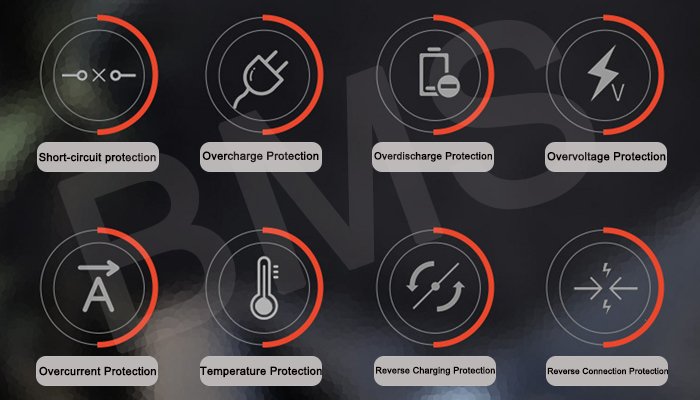
- 1. Lithium Battery Protection
Similar to PCM, it provides protection against overcharging, over-discharging, overheating, overcurrent, and short circuits. For standard lithium manganese batteries and ternary lithium batteries, the system automatically cuts off the charging or discharging circuit if any cell voltage exceeds 4.2V or falls below 3.0V. If the battery temperature exceeds its operating range or the current exceeds the battery's discharge limit, the system automatically interrupts the electrical path to ensure battery and system safety.
- 2. Energy Balance
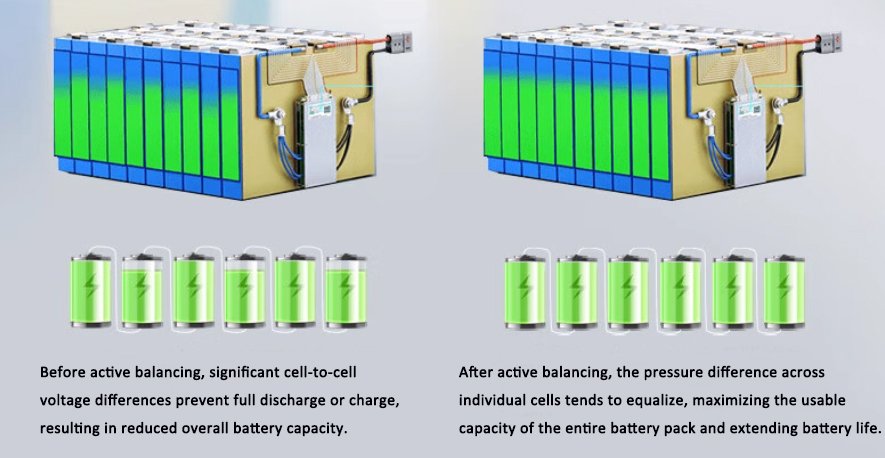
The entire battery pack, consisting of numerous cells connected in series, will eventually exhibit significant performance variations after prolonged operation. These discrepancies arise from inherent cell inconsistencies and variations in operating temperatures, significantly impacting battery lifespan and system performance. Energy balancing addresses these individual cell differences through active or passive charging/discharging management, ensuring cell consistency and extending battery longevity.
Within the industry, there are generally two types of balancing methods: passive balancing and active balancing. Passive balancing primarily achieves equilibrium by dissipating excess charge through resistors, while active balancing transfers charge from batteries with higher charge levels to those with lower levels via capacitors, inductors, or transformers. A comparison of passive and active balancing is shown in the table below.
| Comparison Item | Passive equalization | Active balancing |
| Balancing Method | Resistance dissipation | Inductance Transfer |
| Equilibrium Efficiency | Low | High |
| Solution Maturity | Mature | More mature |
| System Complexity | Low | High |
| System Cost | Low | High |
Due to the relative complexity and higher cost of active equalization systems, passive equalization remains the mainstream approach.
- 3. SOC Computing
Battery capacity calculation is a critical component of the BMS, as many systems require relatively precise knowledge of remaining charge. With technological advancements, numerous methods have been developed for SOC calculation. For applications with lower accuracy requirements, remaining capacity can be estimated based on battery voltage. More precise methods primarily include current integration (also known as the Ah method), where Q = ∫i dt, as well as internal resistance methods, neural network methods, and Kalman filtering methods. The current integration method remains the industry standard.
- 4. Communications
Different systems have varying requirements for communication interfaces, with mainstream options including SPI, I2C, CAN, and RS485. Among these, automotive and energy storage systems primarily utilize CAN and RS485.