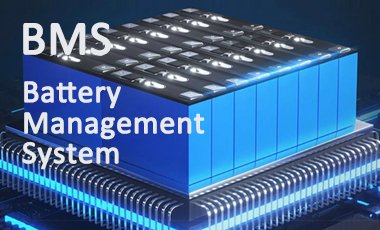






Discover the essential role of the Battery Management System (BMS) in lithium battery packs. Learn how this protection board ensures safety, prevents overcharge/discharge, balances cells, and maximizes battery performance and lifespan. A must-read guide.
What is a BMS and Why It's Essential for Lithium Batteries?
A BMS is a circuit board that manages a rechargeable battery pack. Its primary job is to:
- Protect the Battery: Prevent it from operating outside its Safe Operating Area (SOA), which is crucial as lithium-ion cells can catch fire or explode if abused.
- Prolong Battery Life: Ensure the battery operates in a way that minimizes degradation.
- Monitor Status: Provide information about the battery's state to the user or the larger system (e.g., an EV's dashboard).
Core Functions & How They Protect Your Battery
Here are the fundamental tasks a BMS performs, often in real-time:
A) Protection & Safety (The "Bodyguard")
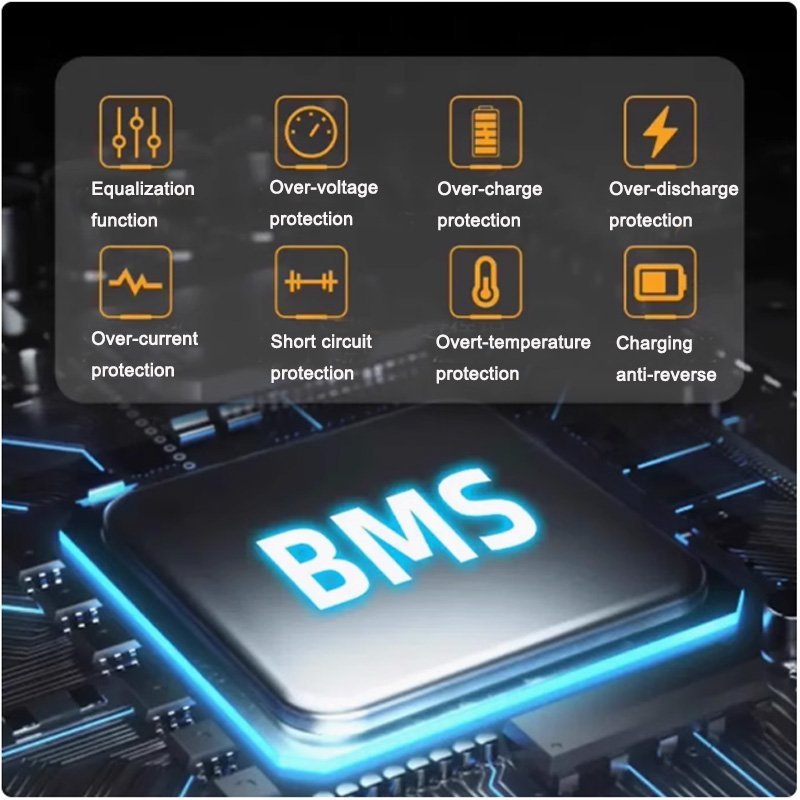
This is the most critical function. The BMS continuously monitors and will disconnect the battery if any of these limits are exceeded:
- Over-Voltage Protection (OVP): Prevents charging the cell voltage too high, which can cause lithium plating and thermal runaway.
- Under-Voltage Protection (UVP): Prevents discharging the cell voltage too low, which can cause irreversible damage to the anode.
- Over-Current Protection (OCP): Limits current during charging (e.g., a faulty charger) and discharging (e.g., a short circuit).
- Short-Circuit Protection (SCP): A very fast-acting version of OCP.
- Over-Temperature Protection (OTP): Monitors cell temperatures and disables operation if they become dangerously high (or sometimes too low for charging).
B) Cell Balancing (The "Equalizer")
In a multi-cell series pack, no two cells are perfectly identical. Some will have slightly more or less capacity. During charging, a weaker cell will reach its maximum voltage before the others. Without balancing, the BMS would stop the entire pack from charging to protect that one weak cell, leaving the rest undercharged.
- How it works: The BMS actively or passively equalizes the charge across all cells.
Passive Balancing: The BMS bleeds a small amount of energy as heat from the highest-voltage cells until they match the lower ones. Simple and cheap, but inefficient.
Active Balancing: The BMS shuttles energy from the highest-voltage cells to the lowest-voltage cells. More complex and expensive, but much more efficient, especially for large packs.
C) Monitoring & State Estimation (The "Informer")
The BMS calculates and communicates key information:
- State of Charge (SoC): The "fuel gauge" (% of charge remaining). This is surprisingly difficult to calculate and is typically estimated by coulomb counting (tracking current in/out) and voltage correlation.
- State of Health (SoH): The overall condition and aging of the battery, expressed as a percentage of its original capacity.
- State of Power (SoP): The maximum charge/discharge power the battery can safely deliver at a given moment (critical for EV acceleration and regen braking).
D) Communication & Interface
The BMS needs to talk to other devices:
- The User: Via an LED bar gauge or a display.
- The Charger: To tell it the correct charging voltage and current, and when to stop.
- The Main Controller: (e.g., in an EV or a solar inverter) to report SoC, faults, and power limits. Common communication protocols include CAN Bus (in vehicles), I2C, SPI, or UART.
Ready to build a safer, smarter battery pack? Explore our selection of high-quality, certified BMS units for various chemistries and applications, or contact our experts for a custom solution.