






- 1. Lithium Battery Charge-Discharge Curve
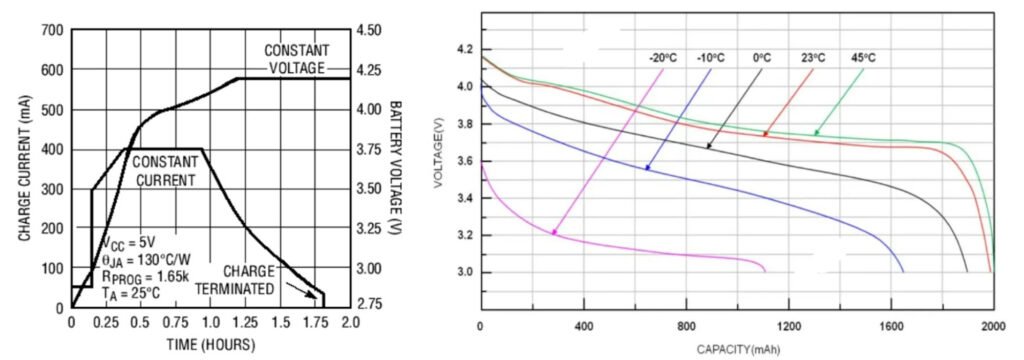
The charge-discharge curve of a lithium battery refers to the relationship curve between the battery's capacity and open-circuit voltage. Based on the battery's discharge curve, the remaining charge can be roughly estimated, as shown in the figure below.

The charge-discharge curve of lithium batteries is not only related to the magnitude of the charging and discharging currents but also to temperature. As shown in the figure below.
- 2. Key Parameters of Lithium Batteries
Due to their inherent characteristics, lithium batteries must not be overcharged, over-discharged, subjected to excessive current, or exposed to excessive temperatures. Therefore, to ensure safety and battery longevity, appropriate protective measures must be implemented. Several commonly encountered parameters are listed below.
| Comparison Item | Ternary Lithium | Lithium iron phosphate |
| Voltage | 3.6V | 3.2V |
| Charge termination voltage | 4.2V | 3.6V |
| Discharge termination voltage | 3.0V | 2.0V |
| Operating Temperature Range | -20℃~60℃ | -10℃~65℃ |
| Maximum Discharge Rate | 3℃~10℃ | 3℃~10℃ |